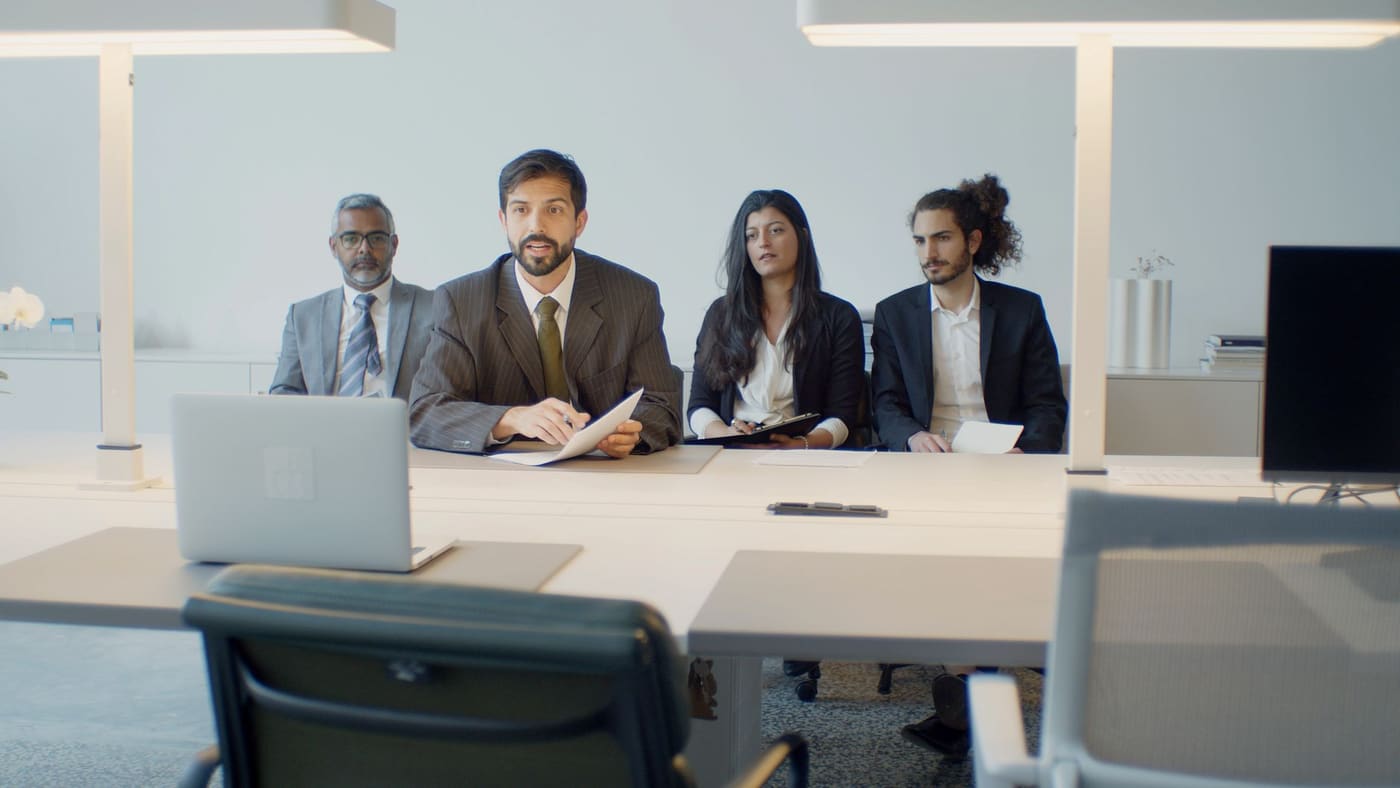
To handle a panel interview without losing your thread, treat it as several short conversations. Look mainly at whoever asked the question, bring the other panelists in as you speak, jot a keyword or two for each question, and answer in a simple order: the answer first, one example, a brief close. Then stop and let them follow up.
Panels feel harder mainly because of logistics: more faces to watch, questions arriving from different angles, and less feedback from any single person. The underlying skills are the same as in a one-on-one interview. What changes is how you manage attention.
What a panel interview is
A panel interview has two or more interviewers questioning you at the same time. Career-center guidance describes the panelists as people from different parts of the organization, often the hiring manager, a future teammate, and someone from another team or from HR. Employers use panels to save time and to gather several opinions on one candidate, though practice varies by employer and role, so do not assume a particular size or format.
Because the panelists usually compare notes afterward, each person’s impression matters. That is the reason to speak to the whole group and not only the friendliest face.
Find out who and what before the day
Ask the recruiter or scheduler for the names and titles of the panelists, the length, whether there is a presentation or exercise, and whether it is in person or on video. Then think about what each role is likely to care about: a manager may care about results, a teammate about how you work with others, someone from another department about how you will collaborate with them. Choose one example that would speak to each.
If you cannot find names, prepare examples that cover your technical skill, teamwork and communication. A story bank suits panels well, because the questions are varied and fast.
Eye contact and attention
The common mistake is either staring only at the questioner or flicking between faces too quickly. Career-center guides for panel interviews generally suggest the same pattern, and it is easy to follow:
- Look at the questioner while they ask and for the start of your answer.
- Move your gaze around the panel during the middle, a second or two per person.
- Come back to the questioner as you finish.
If someone is writing and not looking up, do not chase their eyes. Glance their way now and then and keep going. On video, look at the camera for part of your answer, since looking at faces on the screen reads as looking down. Include a quiet panelist with a glance or a nod when you finish a point, because quiet people are sometimes the decision-makers.

Keep your thread with a simple note system
You lose the thread most often when a question has two parts or when someone cuts in mid-answer. A small system prevents most of it.
- Bring a notepad and pen, or keep a note open on a video call. Taking notes in an interview is normal.
- Write keywords, not sentences. For “How do you prioritize, and can you give an example?” write “1 method, 2 example”.
- Write each panelist’s name and role at the top, in seating order. It helps you address people and write follow-up notes later.
- Pause for two or three seconds and look at your keywords before you speak. A short pause usually reads as thoughtful.
If you lose your place, say, “Let me make sure I’ve covered your question. You asked about X, and so far I’ve covered Y,” and finish. That is better than trailing off. For more resets, see recovering from a bad start to an answer.
Answer in a shape the panel can follow
With several people listening, long answers lose attention. Many interview-prep guides suggest answers of roughly one to two minutes, which is convention rather than a researched limit. A workable shape is:
- Answer first, in one sentence.
- Support: one short example or two or three reasons.
- Close: a line that ties back to the role.
Here is an invented example for “How do you handle competing deadlines?” (use your own true details):
“I rank tasks by deadline and impact, then confirm priorities with whoever depends on the work. For example, when a report and a client presentation fell in the same week, I asked my manager which carried more risk, blocked time for each, and told the report’s recipient when to expect it. Both went out on time.”
Then pause. If they want more, they will ask. Filling the silence with extra detail is the usual way answers drift.
Interruptions, skeptics and two questions at once
Panels are less orderly than one-on-ones, so expect some of this.
- Interrupted: let them finish, answer what they asked, and return to your earlier point only if it still matters.
- A skeptical panelist: stay factual. “That’s a fair point. Here is how I thought about it” works better than defending. Some panelists take the skeptic’s role on purpose to see how you respond.
- Two questions at once: note both, answer one, then say, “And on your second question.”
- You do not know: say so and explain how you would find out. Do not bluff.
- Panelists disagree with each other: do not take a side; speak to the substance.
Speaking to different panelists
This table is a rough guide, not a rule, since panelists differ.
| Panelist | Likely interest | How to speak to them |
|---|---|---|
| Hiring manager | Results, ownership, team fit | Lead with outcomes and your role |
| Peer or teammate | Day-to-day working style | Describe how you share work and communicate |
| Technical specialist | Depth and accuracy | Be precise and do not overstate |
| HR or recruiter | Consistency, values, logistics | Be clear and concise |
| Senior leader | Judgment and the big picture | Link your work to wider goals |
Closing the panel
When you are asked for questions, direct different ones to different people: something about the typical week to a teammate, something about the first six months to the manager. Questions to ask at the end of an interview has options. Thank everyone as you leave. If you have contact details, career-center guides suggest a short personal note to each panelist, mentioning something specific from your conversation with that person. If you only have the coordinator’s address, send one note and ask them to pass on your thanks. Writing the thank-you email covers how.
Practice that fits panels
Ask two or three friends or family to question you at once for 15 minutes. It will feel awkward, which is the point: you rehearse the attention-splitting, not the words. Do not memorize answers. Preparing without over-rehearsing explains how to be prepared without sounding scripted.
Where this comes from
This article draws on university career-center guidance on panel and group interviews (including the University of Connecticut’s career center), which agrees on facing all panelists, researching their roles and thanking each person, and on general interview-preparation conventions. Nothing here is based on outcome data: no source shows that a particular eye-contact pattern or answer length changes hiring decisions, so treat the advice as good practice. Interview formats and employer practices change, so check the details the recruiter gives you.